
28

Jan 28th, 2026

Olivia Kortepeter




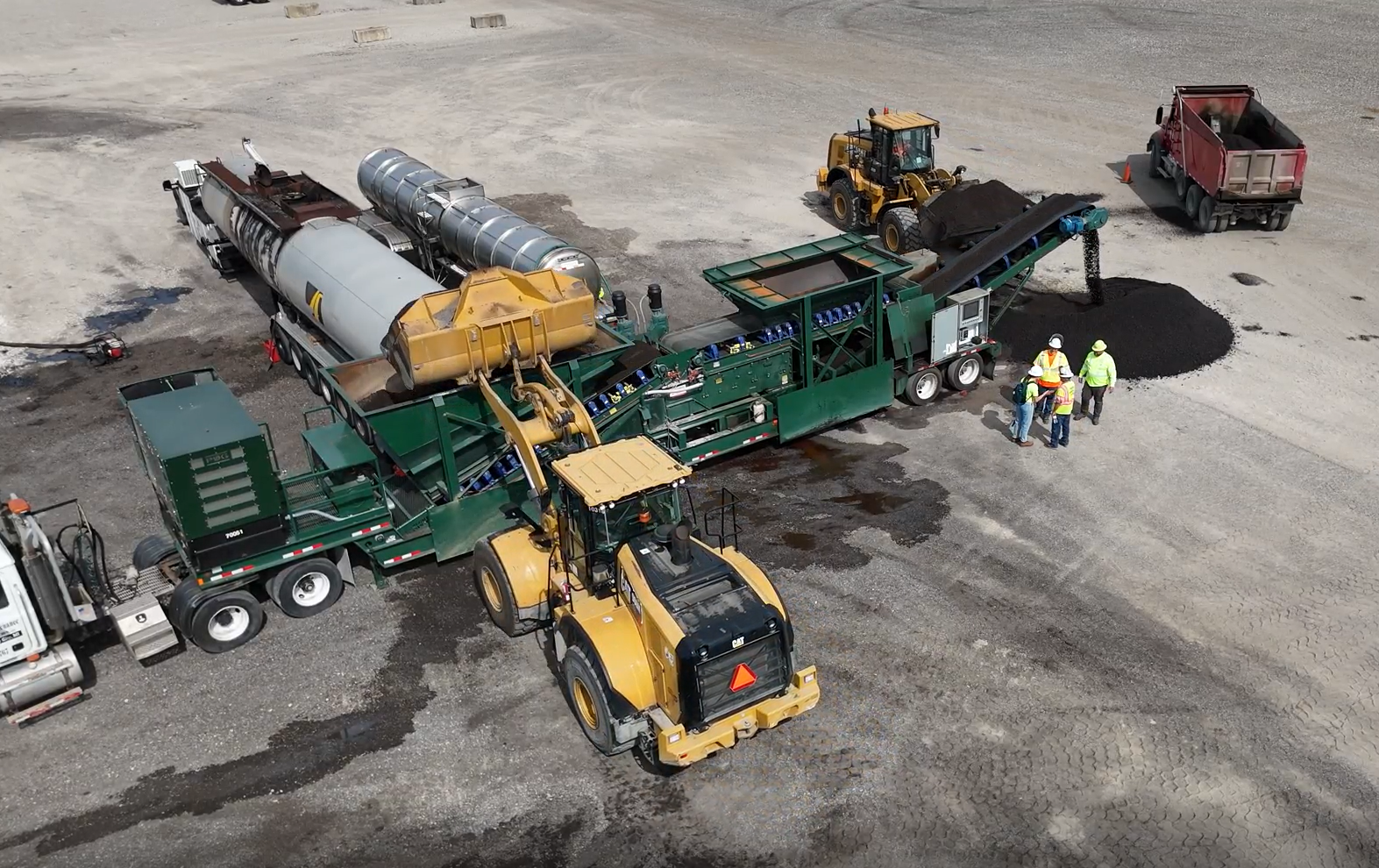
The need for cost-effective and sustainable methods continues to push innovation in road construction. Over the past few decades, technology has advanced to deliver cold mixes with durability comparable to traditional hot mixes—without the energy-intensive heating process.
One promising technique is Cold In-place Recycling (CIR), which has gained popularity for its ability to reduce costs and environmental impact when rehabilitating pavements with deep structural distress. But what happens when recycling in-place with a long train of machines is not feasible, or when high-quality Reclaimed Asphalt Pavement (RAP) piles are already available? That is where Cold Central Plant Recycling (CCPR) comes in.
CCPR involves processing RAP—either from new millings or existing stockpiles—at a central location near the job site. The recycled material can then be used as a base or binder in new construction, or to widen and pave shoulders.
State Route 13, just south of Lapel, Indiana, was in need of major rehabilitation. Significant structural distress meant deep reconstruction, an expensive endeavor. However, the Indiana Department of Transportation (INDOT) saw an opportunity to apply CCPR as an interstitial layer, reducing costs and environmental impact.
The process began with milling the top 5 inches of asphalt from the roadway. The reclaimed asphalt pavement (RAP) was hauled to a nearby central location for transformation. Meanwhile, the road base underwent 10 inches of cement Full Depth Reclamation (FDR) to correct deep structural issues.
At the central site, the RAP was crushed and blended with a cationic asphalt emulsion, water, and surfactants in a specially designed portable pug mill. The recycled mix was then transported back to the layout area, paved 3 inches deep using conventional equipment—without heat—and compacted with vibratory rollers.
Once compacted, the road reopened to local traffic immediately, with instructions to avoid sharp turns or sudden stops on the fresh surface. The mix was engineered to release water and gain strength during curing. After reaching less than 3% moisture content—or after 10 rain-free days—it was ready for the final surface course: 2 inches of 9.5 mm Hot Mix Asphalt (HMA).
Quality control started before the first truck arrived. Engineers sampled the existing pavement to confirm its suitability for CCPR. Cores were collected and tested to determine the precise emulsion content required for optimal performance.
Performance testing focused on:
During production and laydown, the team monitored quality using nuclear density gauges, depth checks, pulverized material gradation, emulsion and water content, and field moisture measurements.
By choosing CCPR for State Route 13, INDOT reduced trucking needs, cut raw material costs and lowered carbon emissions, all while delivering a durable roadway with a long service life.
For more success stories, visit Road Resource or reach out to discuss how CCPR can benefit your network.